If you have searched for vinegar health benefits, you have almost certainly encountered apple cider vinegar (ACV). It is one of the most talked-about functional foods of the past decade, and the research behind it is real and worth taking seriously. But ACV is only one entry in a much larger category: functional vinegar tonics. Understanding where ACV sits within that category, and where other medicinal vinegars differ, is the key to choosing the daily tonic that best matches your wellness goals. This article breaks down the differences clearly, without overstating what the science currently says.
- Apple cider vinegar is made from fermented apple juice and remains the most commercially available vinegar tonic worldwide.
- Medicinal or functional vinegars are a broader category built on diverse botanical sources — fruit, honey, berries, and roots — each contributing a distinct bioactive profile.
- Both categories share acetic acid as their principal active compound, linked in human research to steadier post-meal blood sugar responses Johnston et al., Diabetes Care 2004 Shishehbor et al., Diabetes Research and Clinical Practice 2017; the botanical source determines the additional benefit layer.
- ACV functions as a general-purpose daily tonic; functional vinegars are formulated around one specific daily-wellness outcome.
- Neither category treats, cures, or prevents disease — both are functional food products, not medicines.
The Common Ground: Acetic Acid
Every vinegar, regardless of its botanical source, is defined by its acetic acid content. Acetic acid forms during the second stage of fermentation, when Acetobacter bacteria convert ethanol into this organic acid.
A widely cited human trial found that a standard vinegar serving taken with a high-carbohydrate meal improved whole-body insulin sensitivity by roughly 34% in participants with insulin resistance or type 2 diabetes, and reduced the post-meal rise in blood glucose and insulin Johnston et al., Diabetes Care 2004. A 2017 systematic review and meta-analysis of multiple clinical trials confirmed that vinegar consumption can measurably attenuate post-meal glucose and insulin responses across study populations Shishehbor et al., Diabetes Research and Clinical Practice 2017. A 2014 mechanistic review proposes this may work partly by slowing the activity of alpha-amylase, the enzyme that breaks down starch, and by delaying gastric emptying — mechanisms that may also support digestive comfort Petsiou et al., Nutrition Reviews 2014.
In this sense, apple cider vinegar and a premium longan vinegar tonic share a foundational mechanism. The differences begin when you look beyond acetic acid at the botanical matrix each vinegar carries.
What Makes Apple Cider Vinegar Distinctive
Apple cider vinegar is produced from pressed apple juice. Yeast ferments the natural apple sugars into alcohol, which Acetobacter bacteria then ferment a second time into acetic acid.
The resulting liquid typically contains:
- Acetic acid, the primary active compound, typically 4-6% by volume
- Malic acid, a naturally occurring fruit acid with some studied digestive associations
- Trace polyphenols from apple skin, though levels are typically modest
- The "mother" in raw, unfiltered versions — strands of protein, enzymes, and friendly bacteria carried over from fermentation
What the Research Says About ACV
ACV has been studied in relation to post-meal blood sugar management, satiety, and lipid metabolism Petsiou et al., Nutrition Reviews 2014. The research is credible, if modest in scale, and the general conclusion is that ACV may offer genuine, measured benefits when consumed consistently as part of a balanced diet — not a dramatic or guaranteed effect.
What ACV does not offer is a targeted functional profile for a specific wellness outcome such as sleep, immune support, or gut-lining comfort. It is a broadly beneficial general tonic, not a precision one.
What Makes Functional Vinegar Tonics Different
Functional vinegar tonics are formulated around a specific botanical and a named wellness purpose. Rather than selecting a fruit for general fermentability, the botanical is chosen because its traditional use and studied bioactivity align with a defined daily-wellness outcome.
Botanical Source Diversity
Instead of apple, a functional vinegar tonic may be built on longan, sea buckthorn, or honey, among other botanicals — each carrying a distinct traditional-use history and compound profile.
Longan: a fruit with a documented history of traditional use associated with calming effects and support for restful sleep — an application modern research is now beginning to examine. The underlying mechanisms are still being characterised: a small 2023 human pilot study on longan syrup (not fermented vinegar) reported encouraging early signals for sleep quality among people with insomnia, though the evidence remains preliminary Ramathibodi Medical Journal 2023.
Sea Buckthorn: one of the most nutrient-dense small berries studied in functional food science, with a naturally high content of vitamin C, vitamin E, and phenolic compounds that contribute to measurable antioxidant activity — an underlying mechanism relevant to immune and inflammatory support Ma et al., Food Chemistry 2020.
Honey: when properly fermented, raw honey produces organic acids and enzymatic activity, and a 2022 review of the evidence found that honey's natural oligosaccharides and polyphenols may act as prebiotic compounds that support beneficial gut bacteria Schell et al., Frontiers in Nutrition 2022.
Purpose Specificity
ACV is positioned as a general wellness tonic. Functional vinegars are formulated for a named outcome, and the botanical is selected to support that outcome through its own compound profile, not through acetic acid alone.
This distinction matters because it shapes how you integrate the tonic into your daily routine. A longan vinegar tonic is typically taken in the evening; a sea buckthorn tonic at the start of the day; a honey vinegar tonic before your largest meal.
Formulation Precision
Commercial ACV varies in quality, acetic acid concentration, and botanical consistency between brands and batches. Premium functional vinegar tonics are manufactured to consistent specifications — controlled fermentation timelines, standardised serving sizes, and verified acetic acid content.
ARKA Botanics applies this precision to each tonic, with a standard serving of approximately 10 ml designed to deliver a consistent botanical dose in every use.
Side-by-Side Comparison
The comparison below summarises the core differences at a glance.
- Botanical source — ACV: fermented apple juice. Functional vinegar: longan, sea buckthorn, honey, or other selected botanicals.
- Primary active compound — Both: acetic acid, produced through the same two-stage fermentation process Johnston et al., Diabetes Care 2004.
- Additional compounds — ACV: malic acid, trace apple polyphenols. Functional vinegar: botanical-specific compounds such as vitamin C and E (sea buckthorn), traditional calming compounds (longan), or prebiotic oligosaccharides (honey).
- Wellness purpose — ACV: general-purpose daily tonic. Functional vinegar: formulated for one named outcome, such as sleep support, immunity, or digestion.
- Formulation consistency — Standard ACV: varies by brand and batch. Premium functional vinegar: standardised serving size and verified acetic acid content.
- Typical serving — ACV: varies by brand, often diluted 15-30 ml. ARKA Botanics functional tonics: approximately 10 ml, diluted in water before a meal.
Which One Is Right for You?
If you are looking for a general-purpose daily vinegar tonic with a broad evidence base and wide availability, apple cider vinegar is a well-founded starting point.
If you have a specific daily-wellness priority — supporting more restful sleep, reinforcing everyday immune resilience, or maintaining digestive comfort — a functional vinegar tonic formulated for that purpose gives you a more targeted tool.
You do not have to choose one exclusively. Some people use both: ACV as a morning general tonic and a functional botanical vinegar for a specific purpose later in the day. As with any dietary change, individual responses vary, and beginning consistently rather than sporadically gives you the most accurate picture of how your body responds.
How ARKA Botanics Approaches This Category
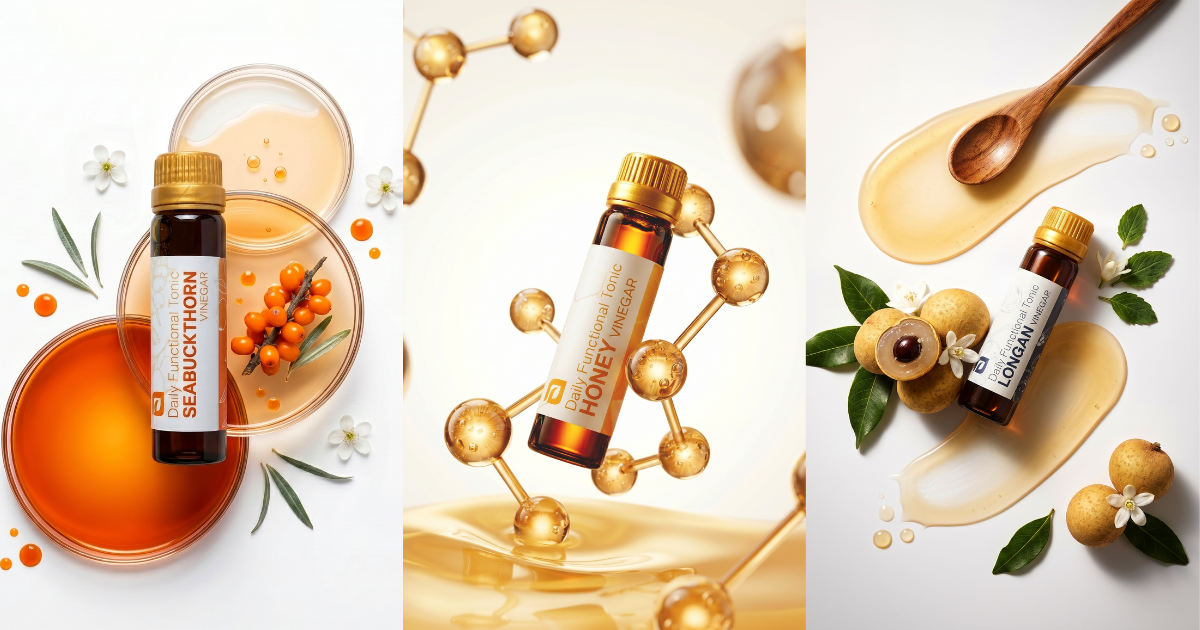
ARKA Botanics is built on the premise that traditional botanical knowledge and modern fermentation science are not competing systems but complementary layers of evidence: historical use identifies a promising botanical, and contemporary research clarifies how and why it performs. Each ARKA Botanics tonic is built on a botanical with documented traditional use, manufactured through a controlled fermentation process to a standardised specification, and formulated around one defined physiological outcome. Read more in ARKA's complete guide, What Are Medicinal Vinegars? A Complete Guide to Functional Vinegar Tonics. All three products below are functional food tonics, not medicines, and are not intended to diagnose, treat, cure, or prevent any disease.
- Longan Vinegar — formulated to support restful sleep
- Sea Buckthorn Vinegar — formulated for daily antioxidant and immune support
- Honey Vinegar — formulated to support digestive comfort
Frequently Asked Questions
Is apple cider vinegar a type of medicinal vinegar?
In the broadest sense, yes — ACV is the most widely known entry in the functional vinegar category. The term "medicinal vinegar" more commonly refers to botanical vinegar tonics formulated for a specific wellness outcome, which is a more targeted formulation approach than standard ACV.
Which has more health benefits: ACV or functional vinegar tonics?
Both share the foundational benefit of acetic acid, which human research links to steadier post-meal glucose and insulin responses Petsiou et al., Nutrition Reviews 2014. Functional vinegar tonics add a botanical layer specific to their stated wellness purpose. Neither "has more health benefits" in absolute terms; the real question is which is more appropriate for your specific wellness intention.
Can I substitute ACV for a functional vinegar tonic?
You can use ACV as a general vinegar tonic, but it will not replicate the botanical-specific properties of a formulated tonic. A longan vinegar tonic for sleep, for example, carries longan-specific compounds that apple fermentation does not produce.
Are functional vinegar tonics safe to take alongside ACV?
For most healthy adults, consuming modest, diluted quantities of vinegar as part of a balanced diet is considered safe. If you are considering using multiple vinegar tonics at the same time, consult a healthcare professional, particularly if you are taking any medications.
How do I take a functional vinegar tonic?
ARKA Botanics recommends diluting approximately 10 ml of the tonic in a glass of water, taken before a meal. For Longan Vinegar, the evening is the preferred timing; for Sea Buckthorn Vinegar, morning; for Honey Vinegar, before your main meal.
Do ARKA Botanics tonics contain allergens?
Please refer to the individual product label for full ingredient and allergen information. Where stated on the label, ARKA Botanics products are suitable for halal and vegetarian diets.
References
- 1. Johnston CS, Kim CM, Buller AJ. "Vinegar Improves Insulin Sensitivity to a High-Carbohydrate Meal in Subjects With Insulin Resistance or Type 2 Diabetes." Diabetes Care, 2004;27(1):281-282. https://diabetesjournals.org/care/article/27/1/281/26582/Vinegar-Improves-Insulin-Sensitivity-to-a-High
- 2. Shishehbor F, Mansoori A, Shirani F. "Vinegar consumption can attenuate postprandial glucose and insulin responses; a systematic review and meta-analysis of clinical trials." Diabetes Research and Clinical Practice, 2017;127:1-9. https://www.sciencedirect.com/science/article/abs/pii/S0168822716308518
- 3. Petsiou EI, Mitrou PI, Raptis SA, Dimitriadis GD. "Effect and mechanisms of action of vinegar on glucose metabolism, lipid profile, and body weight." Nutrition Reviews, 2014;72(10):651-661. https://pubmed.ncbi.nlm.nih.gov/25168916/
- 4. Ma X, et al. "Impact of phenolic compounds and vitamins C and E on antioxidant activity of sea buckthorn (Hippophaë rhamnoides L.) berries and leaves." Food Chemistry, 2020. https://www.sciencedirect.com/science/article/abs/pii/S0308814619319156
- 5. "Effectiveness of Longan Syrup on Improving Sleep Quality Among Insomnia Volunteers." Ramathibodi Medical Journal, 2023. https://he02.tci-thaijo.org/index.php/ramajournal/article/view/261723
- 6. Schell KR, et al. "The Potential of Honey as a Prebiotic Food to Re-engineer the Gut Microbiome Toward a Healthy State." Frontiers in Nutrition, 2022;9:957932. https://pubmed.ncbi.nlm.nih.gov/35967810/