Fermentation is one of humanity's oldest and most sophisticated biotechnologies. Long before microscopes revealed the microbial world, people discovered that certain transformations — grain becoming beer, milk becoming yoghurt, fruit juice becoming vinegar — produced foods and preparations with distinct properties that the original ingredients lacked. Vinegar is, in this sense, one of fermentation's most precise outputs. It begins as a sugar-rich substrate — fruit, honey, grain — and through the sequential action of two distinct microbial populations, it is converted into something biochemically distinct: acidic, stable, and rich in compounds that modern science continues to characterise. This article explains the fermentation science behind vinegar in precise terms: how it is made, what happens chemically during fermentation, what the 'mother' actually is, and why the fermentation process matters for the functional properties of a quality vinegar tonic.
- Vinegar is produced through a precise two-stage fermentation process involving yeasts and acetic acid bacteria.
- Acetic acid — the primary functional compound — is created entirely through fermentation, not present in the original starting material.
- The 'mother' in raw, unfiltered vinegar is a colony of bacteria and enzymes; whether it provides distinct health benefits beyond the vinegar itself is still being researched.
- Fermented vinegars are sometimes described as prebiotics, but the science is nuanced — the prebiotic effect may come more from the starting material (such as honey or fruit) than from the acetic acid itself.
- Fermentation also produces polyphenols and other bioactive compounds from the starting material, which vary depending on what the vinegar is made from.
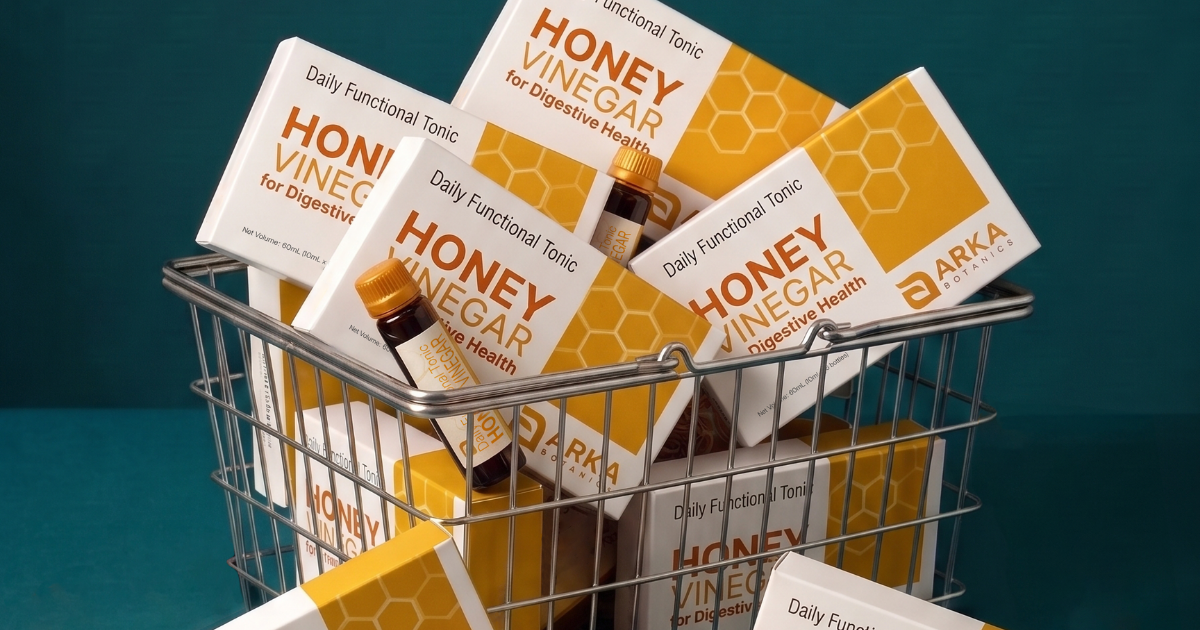
- ARKA Botanics' functional vinegar tonics are made from specific starting materials — longan, sea buckthorn, and honey — chosen for both their traditional significance and the functional compounds they contribute through fermentation.
The Two Stages of Vinegar Fermentation
All vinegar is made through the same fundamental two-stage fermentation process, regardless of the starting material. Understanding these two stages is the key to understanding why vinegar has the properties it does.
Stage One: Alcoholic Fermentation
In the first stage, yeasts consume the natural sugars in the starting material and convert them into ethanol (alcohol) and carbon dioxide. This is the same process that produces wine from grapes, or mead from honey. The yeasts work in the absence of oxygen — this is an anaerobic process — and they continue until the sugar supply is exhausted or until the alcohol concentration becomes high enough to inhibit their activity.
The starting material matters enormously at this stage. Honey, longan fruit, sea buckthorn berries — each contributes a different sugar profile, a different range of polyphenols and plant compounds, and a different set of trace minerals. These differences carry through the fermentation process and influence the character of the final vinegar.
Stage Two: Acetic Acid Fermentation
In the second stage, the alcoholic liquid from stage one is exposed to oxygen and colonised by acetic acid bacteria — principally from the genera Acetobacter and Komagataeibacter. These bacteria are obligate aerobes: they require oxygen to function. They consume the ethanol produced in stage one and convert it, through a two-step enzymatic reaction, into acetic acid and water.
Acetic acid is the defining compound of all vinegars. It is responsible for vinegar's characteristic sharp taste and aroma, and it is the compound most studied in relation to vinegar's functional health properties.
This two-stage process explains why vinegar is genuinely a fermented food in the fullest sense: it has been transformed by living microorganisms, not simply mixed or processed. The final product contains compounds that were not present in the original starting material.
What Is the 'Mother' of Vinegar?
Raw, unfiltered vinegar often contains a cloudy, gelatinous substance known as the 'mother'. This is not a contaminant — it is a colony of acetic acid bacteria embedded in a matrix of cellulose fibres, along with residual enzymes and proteins from the fermentation process.
The mother forms naturally when acetic acid bacteria colonise the surface of the alcoholic liquid during stage-two fermentation. In commercial vinegar production, the mother is typically filtered out before bottling because it creates a cloudy appearance that some consumers find unappealing. In raw and traditionally produced vinegars, it is preserved.
There is ongoing interest in whether the mother provides health benefits beyond those of the vinegar itself. The bacteria in the mother are not typically described as probiotics in the classical sense, because most do not survive passage through the gastrointestinal tract in significant numbers. However, the mother does contain enzymes and proteins that some researchers believe may have functional properties. The science here is still developing, and it would be inaccurate to make strong claims in either direction.
What can be said with confidence is that raw, unfiltered vinegar — with the mother intact — is a less processed product than filtered vinegar, and retains more of the biological complexity produced during fermentation.
Acetic Acid: The Primary Functional Compound
Acetic acid is not a minor constituent of vinegar — it is typically present at concentrations of 4-8% by weight, and it is the compound that gives vinegar its distinctive properties. Understanding what acetic acid does in the body is central to understanding why functional vinegar tonics have attracted scientific attention.
Effects on Digestion
Some studies suggest that acetic acid may support digestive function by stimulating the production of digestive enzymes and hydrochloric acid in the stomach. When consumed before a meal, a small amount of acetic acid may help prepare the digestive system for the work ahead — a mechanism consistent with the pre-meal tonic practices documented in Ayurveda and other traditional medical systems, which modern research is now beginning to examine mechanistically. These effects are being studied and are not yet definitively established in clinical settings.
Effects on Post-Meal Blood Sugar
One of the most studied areas of acetic acid research involves its effect on post-meal glycaemic response. A widely cited 2004 clinical study found that 20 g of vinegar consumed before a high-carbohydrate meal improved whole-body insulin sensitivity by roughly 34% in subjects with insulin resistance or type 2 diabetes, and reduced the post-meal rise in glucose and insulin Johnston et al., Diabetes Care 2004. A later systematic review and meta-analysis of clinical trials confirmed that vinegar consumption can attenuate post-meal glucose and insulin responses across multiple studies Shishehbor et al., Diabetes Research and Clinical Practice 2017.
The proposed mechanisms include a slowing of gastric emptying and a reduction in the rate at which starch is broken down by digestive enzymes such as alpha-amylase — mechanisms reviewed in the broader scientific literature on vinegar and glucose metabolism Petsiou et al., Nutrition Reviews 2014. These findings are meaningful, but should be read as preliminary in clinical scope; functional vinegar tonics are food products, not medicines for blood sugar management, and anyone managing a glucose-related condition should consult a healthcare professional before changing their routine.
Antimicrobial Properties
The acidity created by acetic acid gives vinegar inherent antimicrobial properties. This has been understood empirically since antiquity — vinegar was used to preserve food and clean wounds long before the germ theory of disease was articulated. In the context of gut health, acetic acid's antimicrobial properties may help maintain an environment in which beneficial bacteria can thrive, by suppressing the growth of certain pathogenic organisms. This is an active area of research.
Is Vinegar a Prebiotic?
This is one of the most common questions about functional vinegar tonics, and the answer requires some precision.
A prebiotic is defined as a substrate that is selectively utilised by beneficial microorganisms in the host, conferring a health benefit. By this definition, acetic acid itself is not typically described as a prebiotic — it is not a substrate that gut bacteria consume. However, the picture is more nuanced when we consider the starting materials from which functional vinegars are made.
Honey, for example, contains oligosaccharides — complex sugars that pass undigested through the small intestine and reach the large intestine, where they may selectively feed beneficial bacterial strains. Fruit-based vinegars, depending on the starting material, may retain polyphenols that have been shown to act as substrates for certain beneficial bacteria. A 2022 review in Frontiers in Nutrition identified honey oligosaccharides and polyphenols that showed prebiotic potential in laboratory and preclinical settings Schell et al., Frontiers in Nutrition 2022.
So the more accurate framing is: some functional vinegars — particularly those made from honey or polyphenol-rich fruits — may have prebiotic potential arising from their starting material, rather than from the acetic acid itself. Whether these compounds survive fermentation in sufficient concentrations to exert a meaningful prebiotic effect is a question that requires more research.
What is well-established is that fermented foods as a category — including vinegars — are associated with positive effects on the diversity and composition of the gut microbiome. The mechanisms are complex and not fully understood, but the direction of evidence is consistent.
For a more detailed look at the health benefits associated with daily vinegar tonic use, read The Health Benefits of Daily Vinegar Tonics (and How to Take Them Safely).
Why the Starting Material Matters
Not all vinegars are equivalent from a functional standpoint. The starting material — the fruit, grain, or other substance from which the vinegar is fermented — contributes its own suite of bioactive compounds that persist into the final product.
This is why ARKA Botanics selects its starting materials with care. In each case, the starting material is not merely a sugar source for fermentation — it is a functional ingredient in its own right, chosen because the fermentation process preserves and transforms its characteristic compounds into a tonic that carries the signature of both the ingredient and the process:
- Longan — a fruit with traditional associations with calming and sleep support, studied for its polyphenol content and compounds including quercetin and ellagic acid.
- Sea Buckthorn — one of the most antioxidant-dense fruits known, with documented vitamin C, flavonoid, and carotenoid content that is partially preserved through the fermentation process Ma et al., Food Chemistry 2020.
- Honey — a complex biological substance with documented prebiotic oligosaccharides Schell et al., Frontiers in Nutrition 2022, natural antimicrobial compounds, and a diverse polyphenol profile that varies by floral source.
Why Fermentation Is Not Just Preservation
A common misconception about fermented foods is that fermentation is primarily a preservation technique that happens to have health benefits. The picture is more sophisticated than that.
Fermentation is a transformation. The compounds present in a fermented product are not simply the same compounds as in the original, slightly altered by time. The microbial communities involved in fermentation — both the yeasts of stage one and the acetic acid bacteria of stage two — produce metabolites, enzymatic reactions, and structural changes to the starting material that create genuinely novel functional compounds. In vinegar fermentation specifically, fermentation produces the following:
This is why a quality fermented vinegar tonic is not equivalent to simply acidifying water, or adding a splash of commercial vinegar to a drink. The fermentation process is the point — it is what transforms good starting materials into a functional product. For a foundational overview of what distinguishes functional vinegar tonics from ordinary vinegar products, read What Are Medicinal Vinegars? A Complete Guide to Functional Vinegar Tonics.
- Acetic acid — not present in significant quantities in the starting material
- Polyphenolic transformation products — fermentation can increase the bioavailability of certain polyphenols by breaking apart conjugated forms that the body struggles to absorb
- Organic acids beyond acetic acid — including lactic acid and citric acid, which contribute to the tonic's overall biochemical profile
- Microbial metabolites — including short-chain fatty acids and enzymes produced by the bacteria during fermentation
Frequently Asked Questions
What is the fermentation process for vinegar?
Vinegar is produced through two sequential fermentation stages. First, yeasts convert the natural sugars in the starting material (fruit, honey, grain) into ethanol and carbon dioxide. Second, acetic acid bacteria — principally Acetobacter and related genera — convert the ethanol into acetic acid and water in the presence of oxygen. The result is a liquid with a characteristic sharp taste and a functional profile that differs substantially from the original starting material.
Is vinegar a prebiotic?
Acetic acid itself is not a prebiotic in the classical sense — it is not a substrate consumed by beneficial gut bacteria. However, some functional vinegars made from honey or polyphenol-rich fruits may contain prebiotic compounds inherited from their starting materials, such as honey oligosaccharides, which a 2022 review found may show prebiotic potential in laboratory settings Schell et al., Frontiers in Nutrition 2022. Whether these compounds survive fermentation in meaningful concentrations is still being researched. Vinegar is a fermented food with documented associations with gut microbiome health, but the mechanisms are complex and not fully understood.
What is the mother of vinegar and is it beneficial?
The mother is a colony of acetic acid bacteria embedded in a cellulose matrix, formed during the second stage of vinegar fermentation. It is found in raw, unfiltered vinegars. The mother contains bacteria, enzymes, and proteins. Whether these components provide distinct health benefits beyond those of the surrounding vinegar is an active area of research. The bacteria in the mother are generally not classified as probiotics, as they do not typically survive the gastrointestinal environment in meaningful numbers. However, the enzymes and proteins may have functional properties that are still being studied.
What does acetic acid do in the body?
Acetic acid is studied primarily in three areas: its potential to support digestive enzyme activity when consumed before meals; its observed effects on moderating post-meal blood glucose response — supported by a human trial Johnston et al., Diabetes Care 2004 and a meta-analysis Shishehbor et al., Diabetes Research and Clinical Practice 2017, possibly by slowing gastric emptying and reducing starch breakdown Petsiou et al., Nutrition Reviews 2014; and its antimicrobial properties, which may contribute to a gut environment supportive of beneficial bacteria. These are areas of active research, and functional vinegar tonics are food products, not medicines. Individual responses vary, and anyone with a health condition should consult a healthcare professional.
Does fermentation make vinegar healthier than plain acid?
Yes, in a meaningful sense. Fermentation produces functional compounds — including acetic acid, transformation products of the starting material's polyphenols, organic acids, and microbial metabolites — that are not present in artificially acidified water or diluted chemical acetic acid. A quality fermented vinegar tonic is a genuinely complex biological product, and its functional properties arise from the fermentation process rather than from its acidity alone.
Why does ARKA Botanics ferment from specific starting materials rather than using standard apple cider vinegar?
ARKA's choice of starting materials — longan, sea buckthorn, and honey — is deliberate. Each brings a distinct functional compound profile to the fermentation process: longan contributes polyphenols associated with calm and sleep support; sea buckthorn contributes one of the most antioxidant-dense plant profiles available Ma et al., Food Chemistry 2020; honey contributes prebiotic oligosaccharides Schell et al., Frontiers in Nutrition 2022 and natural antimicrobial compounds. These are not interchangeable with generic vinegar. The starting material is part of the formulation, not incidental to it.
References
- 1. Johnston CS, Kim CM, Buller AJ. "Vinegar Improves Insulin Sensitivity to a High-Carbohydrate Meal in Subjects With Insulin Resistance or Type 2 Diabetes." Diabetes Care, 2004;27(1):281-282. https://diabetesjournals.org/care/article/27/1/281/26582/Vinegar-Improves-Insulin-Sensitivity-to-a-High
- 2. Shishehbor F, Mansoori A, Shirani F. "Vinegar consumption can attenuate postprandial glucose and insulin responses; a systematic review and meta-analysis of clinical trials." Diabetes Research and Clinical Practice, 2017;127:1-9. https://www.sciencedirect.com/science/article/abs/pii/S0168822716308518
- 3. Petsiou EI, Mitrou PI, Raptis SA, Dimitriadis GD. "Effect and mechanisms of action of vinegar on glucose metabolism, lipid profile, and body weight." Nutrition Reviews, 2014;72(10):651-661. https://pubmed.ncbi.nlm.nih.gov/25168916/
- 4. Ma X, et al. "Impact of phenolic compounds and vitamins C and E on antioxidant activity of sea buckthorn (Hippophaë rhamnoides L.) berries and leaves." Food Chemistry, 2020. https://www.sciencedirect.com/science/article/abs/pii/S0308814619319156
- 5. Schell KR, et al. "The Potential of Honey as a Prebiotic Food to Re-engineer the Gut Microbiome Toward a Healthy State." Frontiers in Nutrition, 2022;9:957932. https://pubmed.ncbi.nlm.nih.gov/35967810/